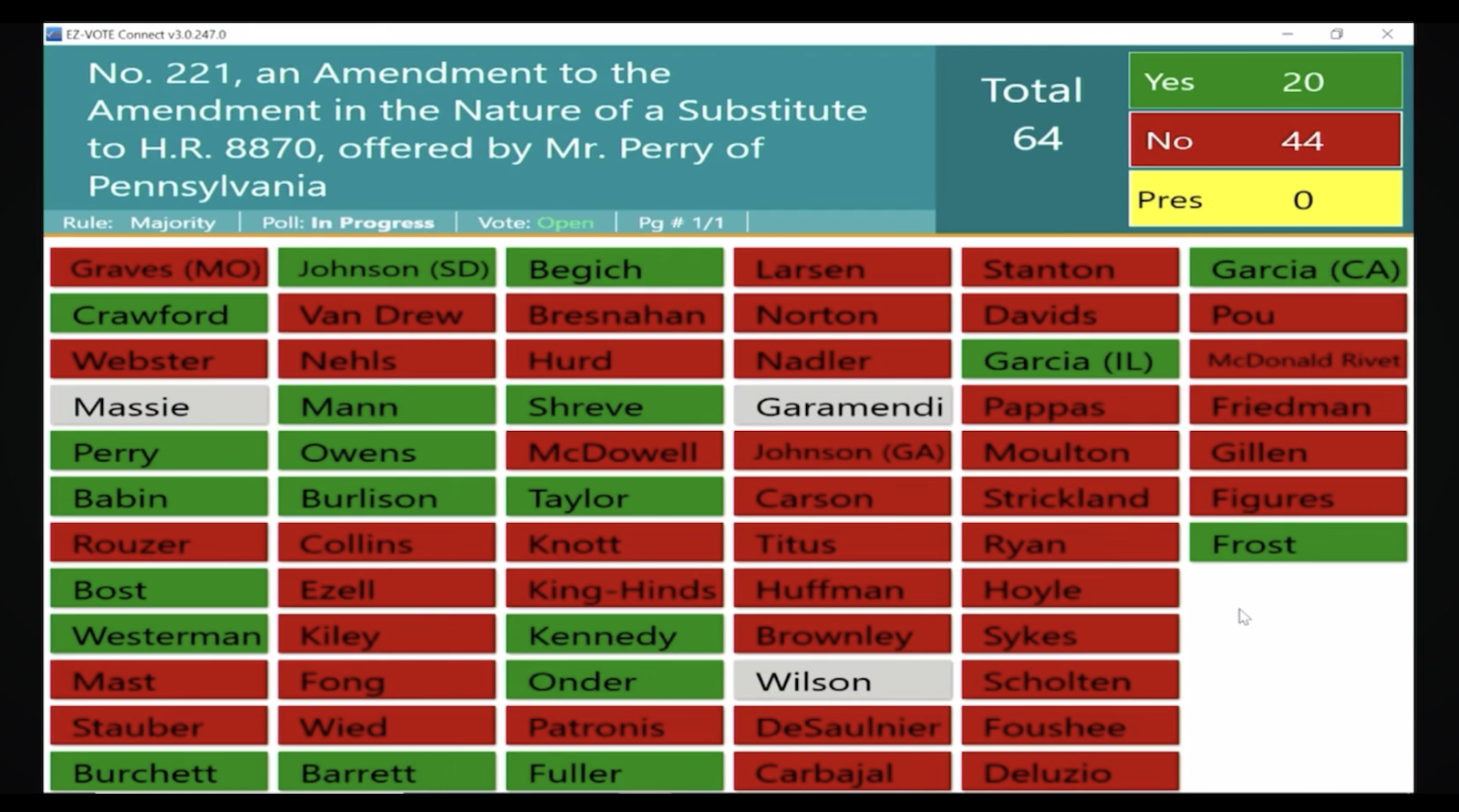
The proposed amendment to prohibit federal highway fund recipients from using Flock and other automated license plate readers (ALPRs) for any purpose except tolling failed 20-44 yesterday. The good news is that legislators from both parties acknowledged the abuses of ALPRs, and most agreed on the need for some regulation. And to be honest, 20 votes is a lot more than I thought were there for an almost-complete ban on ALPRs; a ban wasn’t even on the table in the Washington legislative session.
As Dell Cameron of Wired pointed out on Bluesky, it’s interesting that opposition to ALPRs is greater among Republicans. Of course it’s not absolute; Rep. Maxwell Frost of Florida supported the amendment, as did several other progressive Democrats. But both of Washington state’s Democratic representatives on the committee (Rep. Rick Larsen, a cosponsor of the bill, and Rep. Marilyn Strickland) voted against it. As Demand Progress Executive Director Sean Vitka says
“It’s disgraceful that Rick Larsen and other members of the Transportation and Infrastructure Committee voted to prioritize Flock’s corporate profits over the privacy of the American people. They are on the wrong side of public opinion and history. Dozens of cities across the country have already banned Flock cameras because they are regularly misused to spy on innocent people, riddled with security flaws and Americans don’t want to be warrantlessly surveilled just for being on the road. There is a growing, bipartisan movement fighting against a very real, mass surveillance dystopia where private companies are placing AI-powered cameras on every corner. Surveillance state enablers in Congress like Rick Larsen need to stop putting Flock above the people.”
Larsen was one of a handful of committee members who spoke during the ten-minute debate; his comments start at 11:37:38 (and with luck this link will take you there directly). While acknowledging the problems with ALPRs, Larsen also pointed to the benefits for law enforcement, singling out finding stolen vehicles and helping locate missing endangered persons. And then, unsurprisingly, he highlighted Washington’s SB 6002, which he described as a “balanced approach”, and suggested that it’s a good template for Congress and other states.
Larsen’s description of SB 6002 was interesting, and a preview of talking points we’re likely to hear going forward. According to him, SB 6002
- allows the use of ALPRs in “limited circumstances”. True enough, although the list of authorized uses is quite broad, so this sounds a lot better than it is.
- prohibits data sharing outside the courts. If only! While SB 6002 does have some important warrant requirements, which is good, it also explicitly allows sharing with other Washington state law enforcement agencies — something that police accountability and privacy advocates pushed back on strongly, but to no avail.
- restricts the locations where law enforcement can use ALPRs. This is indeed a strength of SB 6002, which prohibits usage in the “premises or immediate surroundings or access to or from” protected health care facilities, immigration-related facilities, schools (although not universities), places of worship, courts, and food banks.
Larsen also said that “cities that had put a freeze on these systems began using them again with these new restrictions,” which is a misleading over-simplifications. Cities like Everett who had only turned off their ALPRs because of concerns about public records access have in fact turned them back on, since SB 6002 exempted ALPR data from public records requests. On the other hand several cities that were more concerned with abuses and protecting immigrants haven’t turned them on, and in Lynnwood the council cancelled the Flock contract despite ALPR supporters’ claims that SB 6002s protections were sufficient.
Oh well, it is what it is. As Tomas Scheel, a progressive running against Larsen, said on Bluesky
No surprise @repricklarsen.bsky.social voted for this. He hasn’t seen a surveillance program he wasn’t a fan of.
Reminder, he saw ~20 years of the patriot act’s abuses and said “yes please, may I have some more?”Must be nice not having a spouse or family who has been literally in fear of #ICE
More positively, though, with legislators from both parties expressing interest in working with Rep. Perry on a revised version of the amendment, we’re likely to see more discussions of this issue. As an initial skirmish, it went better than I would have thought.
Update: Christie Smythe’s Legislation Killed That Would Have Effectively Blocked Police LPR, Including Flock, on IPVM, has some additional background.
Let your representative know you want to see Congress take action on Flock!
Since we’re likely to see more activity, it’s useful to contact your representative. A short message is fine! Here are a few variants.
If they aren’t on the committee (or you don’t know whether they are or how they voted)
I’m [NAME] from [CITY or COUNTY], a constituent, calling to ask you to ban the use of Flock and other automated license plate readers. I was disappointed that the Transportation and Infrastructure committee voted down a bipartisan amendment to ban ALPR usage for federal highway fund recipients, but legislators of both parties expressed interest in the issue. So please look for other opportunities for Congress to shield Americans from this invasive warrantless surveillance technology that threatens privacy, civil liberties, and constitutional rights.
If they were on the committee and voted yes
I’m [NAME] from [CITY or COUNTY], a constituent, calling to thank Representative [NAME] for the vote in favor of the bipartisan Highway Bill amendment to ban the use of Flock and other automated license plate readers. Please continue to look for other opportunities for Congress to shield Americans from this invasive warrantless surveillance technology that threatens privacy, civil liberties, and constitutional rights.
If they were on the committee and voted no
I’m [NAME] from [CITY or COUNTY], a constituent, calling because I’m disappointed that Representative [NAME] voted against the bipartisan Highway Bill amendment to ban the use of Flock and other automated license plate readers. Going forward, please look for other opportunities for Congress to shield Americans from this invasive warrantless surveillance technology that threatens privacy, civil liberties, and constitutional rights.
The easiest way to do contact your representative is to call the Capitol Switchboard at (202) 224-3121 and ask for your representative’s office. If you hate the phone, you can send a message via your representative’s site; click on your representative’s name in the directory to open their page, and look for the contact information.
Here’s the video of the debate, which starts at 11:29:52.